CFD engine · Standalone & Synera add-in
Raphos LBM
A state-of-the-art lattice-Boltzmann solver for wind tunnels, internal flows and heat transfer, on GPU or CPU.
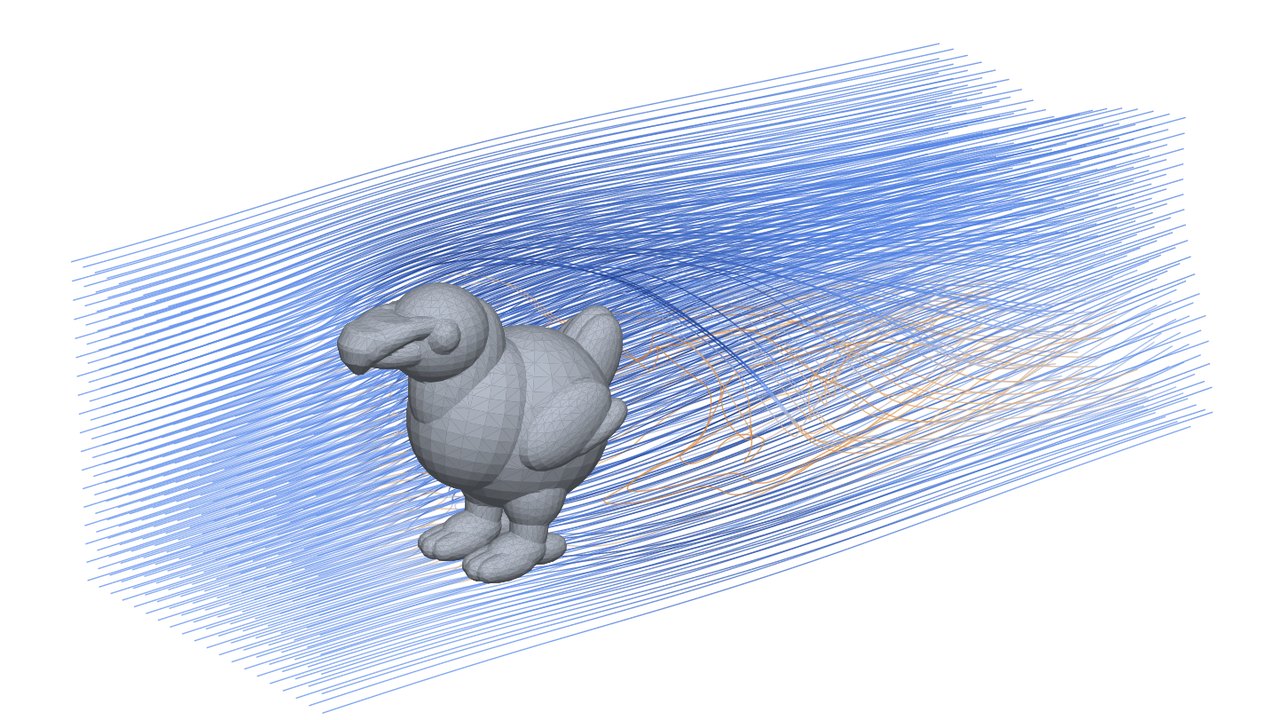
Raphos LBM is our own computational fluid dynamics engine. It solves the lattice-Boltzmann equations on a uniform grid around any mesh, giving transient flow fields, forces and surface pressure without a meshing step: drop in an STL, set the wind speed and run.
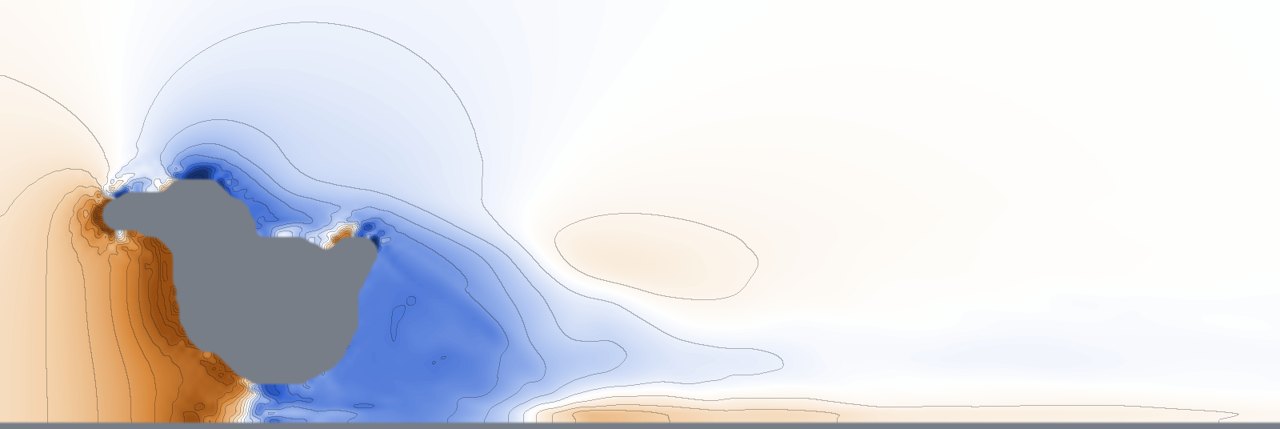
The video and the 3D view above were produced with the standalone engine, outside Synera: a dodo standing on a moving ground plane in a 10 m/s wind, 6.6 million cells with the LES turbulence model. The whole run took about 11 minutes on four CPU cores, at around 60 million lattice updates per second.
State-of-the-art numerics
The engine implements the methods used by today’s fastest lattice-Boltzmann codes, and every one of them is checked against analytic solutions and published benchmarks.
- Cumulant collision on D3Q27 by default, stable and plausible even on under-resolved flows at Re = 10⁶; regularized, TRT and BGK operators for moderate Reynolds numbers.
- Smagorinsky large-eddy simulation for turbulent flows.
- In-place AA streaming with populations stored in FP32 or compressed FP16, halving memory traffic.
- Interpolated (Bouzidi) bounce-back with wall distances from the mesh, moving walls and slip walls.
- Galilean-invariant momentum exchange for forces on each body, every step.
Heat transfer
A coupled energy lattice adds natural and forced convection: Boussinesq buoyancy, turbulent diffusivity from the LES model, and conjugate conduction through solids with per-body heat generation. That makes it suitable for electronics cooling, heated enclosures and thermal comfort studies as well as aerodynamics.
GPU or CPU, standalone or in Synera
The physics is written once and compiled both for NVIDIA GPUs (CUDA) and for AVX2 CPUs, which process eight cells at a time; the CPU backend is the reference the GPU is tested against. The core is a C++20 library with a C API, so it embeds in any pipeline. In Synera it becomes a set of nodes: build a case, run it, and read back forces, flow fields and surface pressure.
A validation gate of 24 cases runs on every change, including Poiseuille flow, Taylor–Green vortices, the lid-driven cavity against Ghia et al. and natural convection against de Vahl Davis.
Interested in Raphos LBM?
Tell us about your problem — we’ll tell you how we’d approach it.