Synera add-in · Geometry processing
Raphos Geometry
Research-grade mesh, surface and point-cloud processing for Synera — the fine-grained operations a BREP kernel does not cover.
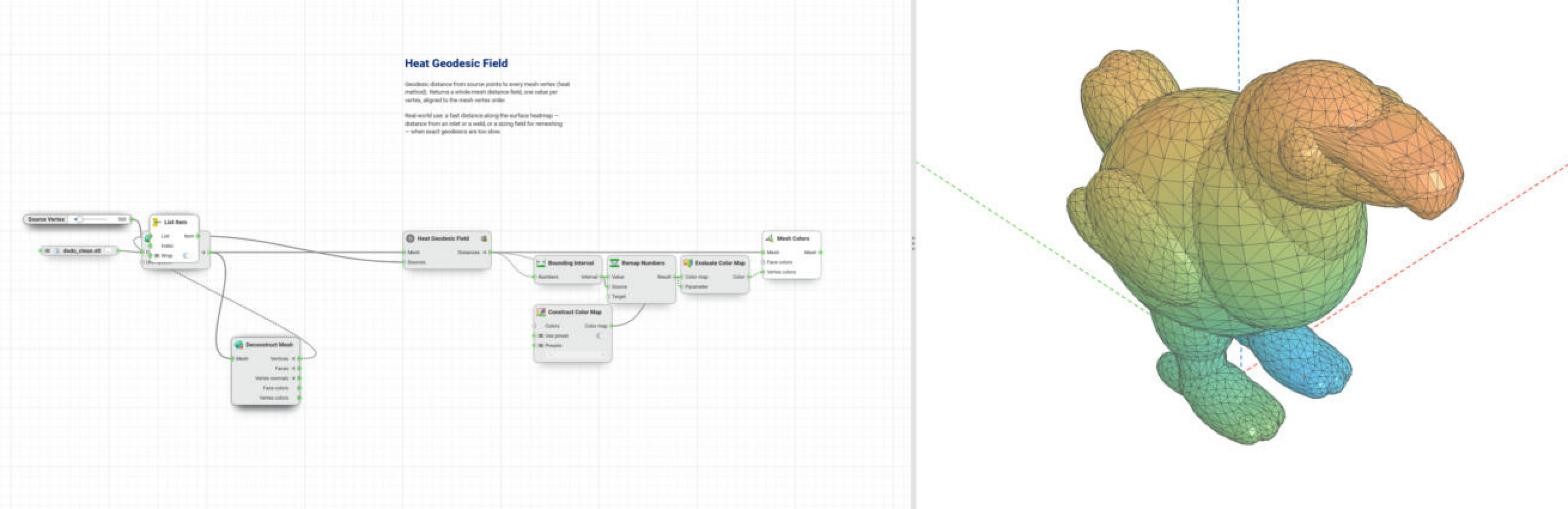
Raphos Geometry brings research-grade triangle-mesh, surface and point-cloud processing to Synera. It covers the fine-grained operations that a Parasolid BREP kernel does not: decimation and repair, geodesic distances, curvature tensors, UV parameterization, winding numbers, marching cubes, deformation and shape detection.
Under the hood is a native C++ layer built on well-respected, permissively licensed libraries — Geogram, Geometry Central, libigl and Eigen — so engineers get the speed and numerical robustness of state-of-the-art geometry code behind ordinary Synera nodes. Every node ships with a runnable example graph.
Forty nodes in three groups
The palette is organized into Mesh, Analysis and Point Cloud groups, so the step from raw scan to clean, analysed geometry stays inside one workflow.
- Mesh: quadric decimation, hole filling, repair, self-intersection removal, alpha wrap, marching cubes, ARAP deformation and UV unwrapping (LSCM, ARAP, harmonic, auto atlas).
- Analysis: curvature tensors, heat and exact geodesics, shortest geodesic paths, vector heat, winding numbers, manifold harmonics, skeletons and Hausdorff distance.
- Point Cloud: normal estimation and orientation, outlier removal, denoising, simplification, Poisson and ball-pivoting reconstruction, RANSAC shape detection and region growing.
From scan to analysis
Typical uses are the jobs that otherwise need a separate tool: sealing a noisy scan into a watertight solid for CFD or printing, checking a manufactured part against nominal CAD with a worst-case Hausdorff distance, routing a seam or cable along the shortest path over a curved surface, or reverse-engineering a scan into planes, spheres and cylinders.
More in Synera Add-ins
Related work.
Interested in Raphos Geometry?
Tell us about your problem — we’ll tell you how we’d approach it.