Paper · IASS 2018, MIT
Optimized quad gridshells from stress and curvature fields
Remeshing a free-form surface into a quad gridshell whose members follow the forces and the shape at the same time.
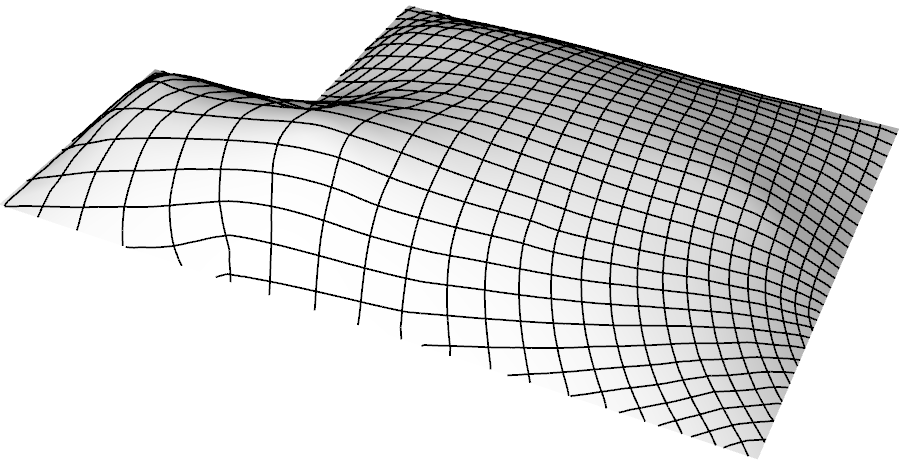
Optimized Quad Gridshell from Stress Field and Curvature Field, by Lorenzo Greco, presented at the IASS Symposium 2018 “Creativity in Structural Design” at MIT.
A gridshell turns a free-form surface into a lattice of members, and the layout of that lattice decides how well it carries load and how easy it is to clad. Quad grids are preferred because they use less steel and simpler nodes than triangles. The usual approach builds a grid along one set of directions, often the principal curvatures, and only then optimises it for stresses. The paper does both at once.
Two fields at once
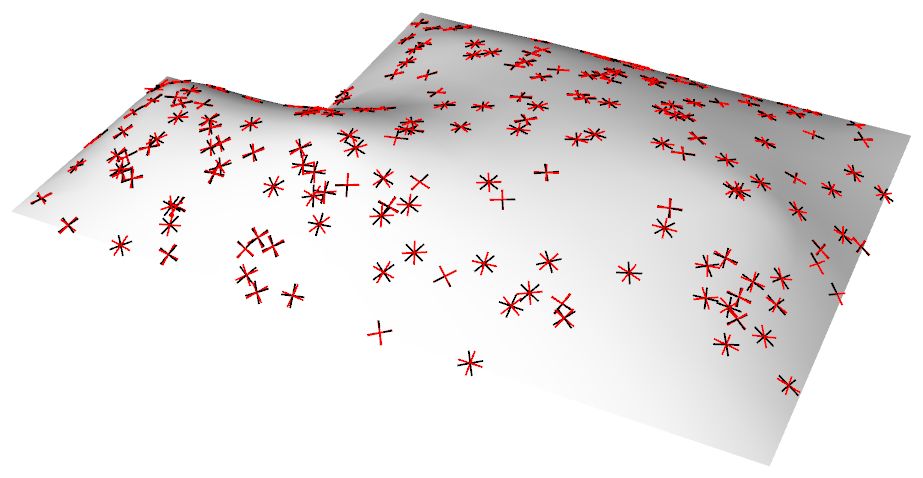
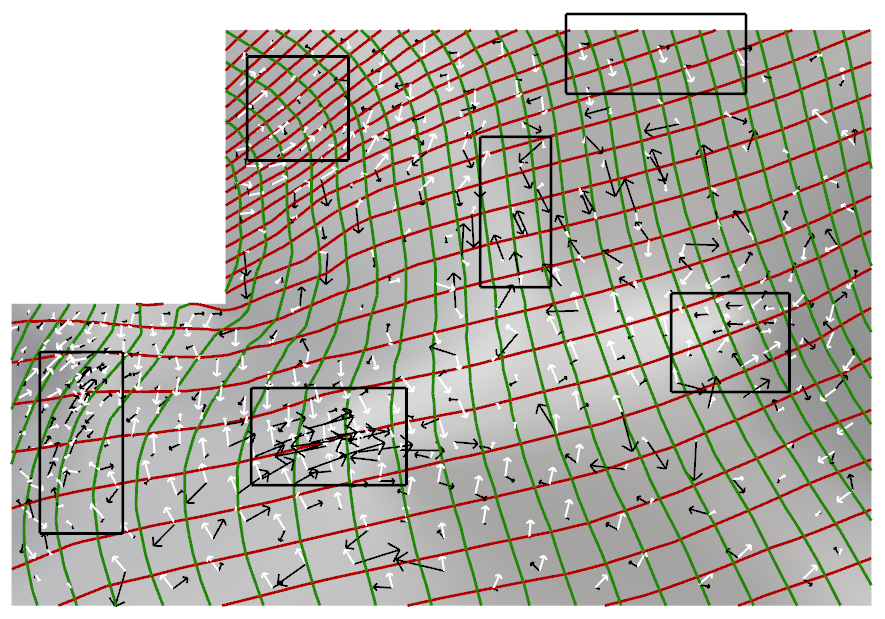
The method cleans the surface, then computes two direction fields on it: the principal curvatures, and the principal stresses from a finite-element analysis. A subset of these vectors is turned into a smooth field, combined into a conjugate field that favours planar panels, and integrated into a quad-only mesh that follows the original surface exactly.
Real time, in Grasshopper
The algorithms come from the computer-graphics libraries CGAL and libigl, wrapped into a new Rhino and Grasshopper plugin called Capybara. Every parameter is exposed, so a designer can remesh a surface in real time and trade structural efficiency against geometry, with smoother and more stable results than particle-system methods.
More in Research
Related work.
Interested in Optimized quad gridshells from stress and curvature fields?
Tell us about your problem — we’ll tell you how we’d approach it.