Paper · IASS 2013, Wrocław
Elastic behaviour of reciprocal systems by homogenization
How stiff is a reciprocal frame? A homogenization model that turns the square nexorade into an equivalent plate, now formally verified in Lean.
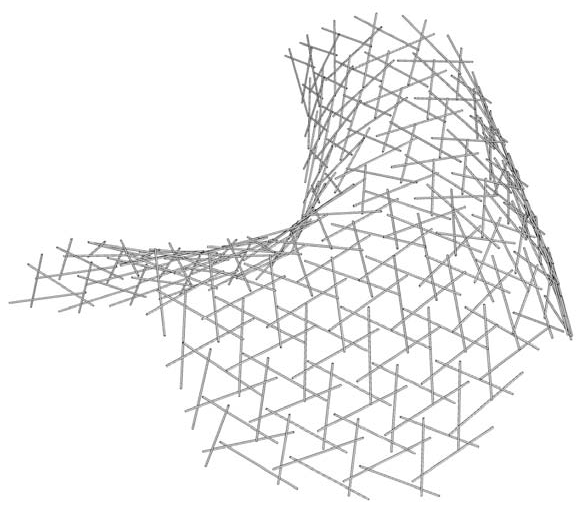
Investigation of the elastic behavior of reciprocal systems using homogenization techniques, by Lorenzo Greco, Arthur Lebée and Cyril Douthe, presented at the IASS Symposium 2013 in Wrocław.
A reciprocal frame, or nexorade, is built from short members that rest on one another in closed loops, so that no member spans the whole structure. The idea goes back to sketches by Villard de Honnecourt and Leonardo, and it is used today for shelters and pavilions. Such frames are easy to build from short pieces but hard to analyse, because every member is loaded in bending by its neighbours.
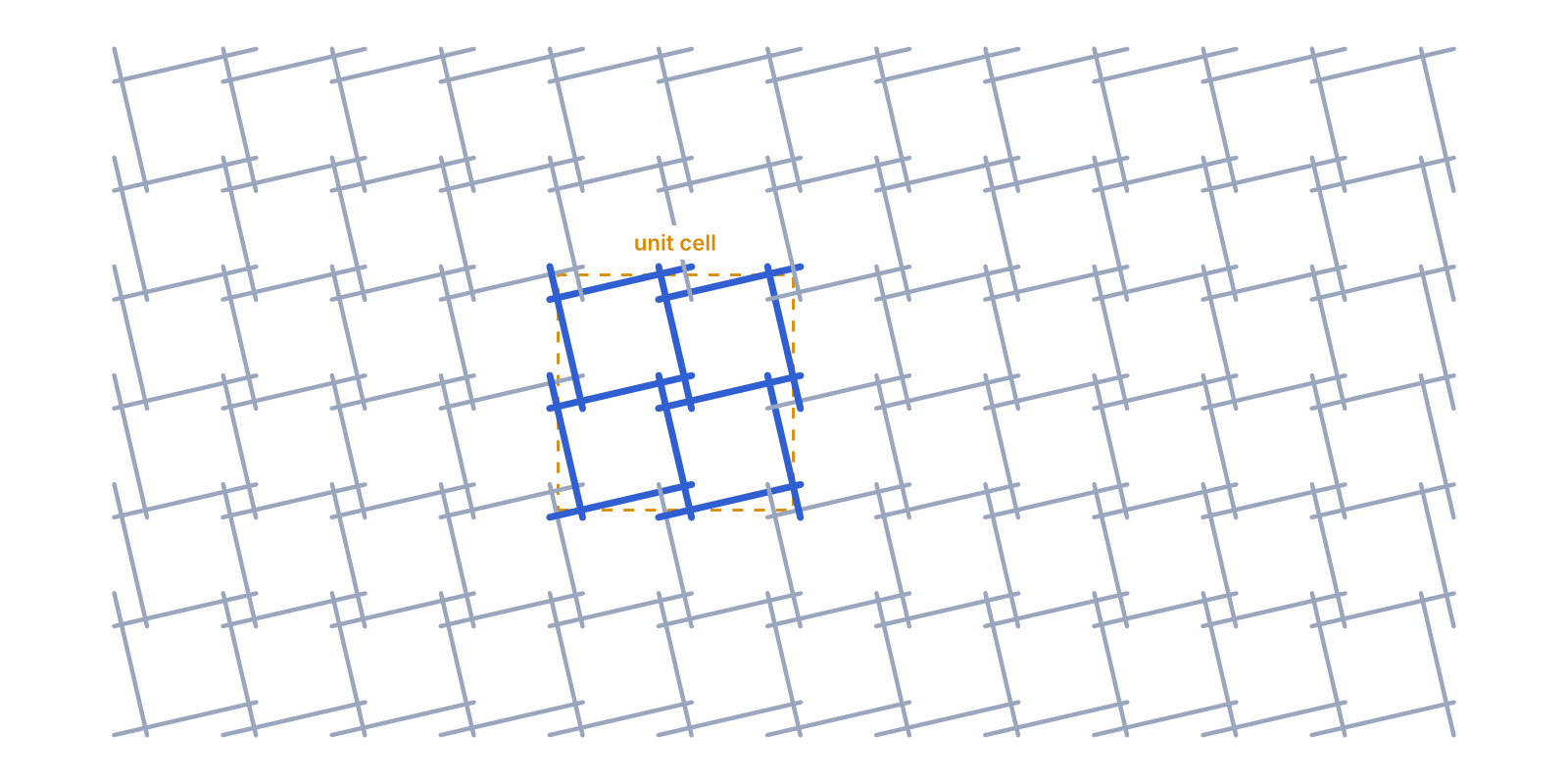
The paper replaces the square nexorade with an equivalent continuous plate. It solves the repeating unit cell, derives the plate’s stiffness in closed form, finds the cell geometry that minimises bending in the members, and checks the homogenized plate against full finite-element models in ABAQUS.
Shelters built from short bars
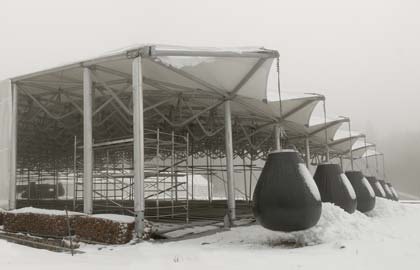
Reciprocal systems have a long history, from medieval timber floors to the shelter over the archaeological site at Bibracte in France. Their appeal is practical: a large span is covered with short, identical members and simple joints. The price is that the structure works in bending everywhere, so a designer needs a quick way to know how stiff it will be.
From a frame to a plate
Homogenization treats a repeating structure as a continuum whose properties come from one representative cell. For the square nexorade, the result is a plate that carries bending very differently from a solid slab, and the paper gives its stiffness in terms of the member geometry. The analytical plate matches the ABAQUS models within a few per cent once the frame has enough cells.
- Unit-cell solution in four-point bending.
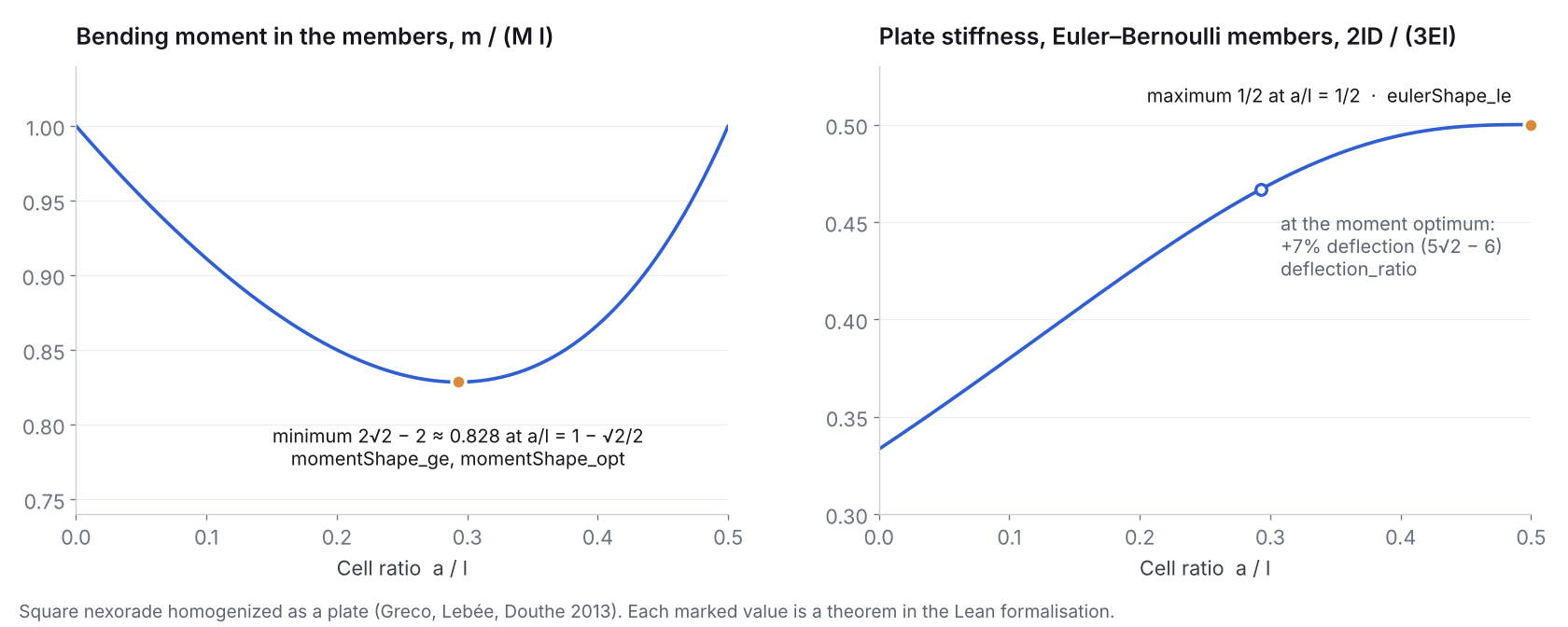
- Equivalent plate compliance and stiffness in closed form.
- The cell ratio that minimises member bending: a/l = 1 − √2/2.
- Navier solution of the homogenized plate under load, checked against ABAQUS.
Checked line by line in Lean
The full paper is now formalised in Lean 4, in the papers/Nexorade folder of our open-source lean-mechanics library. Each closed-form result is restated and proved from first principles, with no unfinished proofs and no extra axioms.
More in Research
Related work.
Interested in Elastic behaviour of reciprocal systems by homogenization?
Tell us about your problem — we’ll tell you how we’d approach it.